
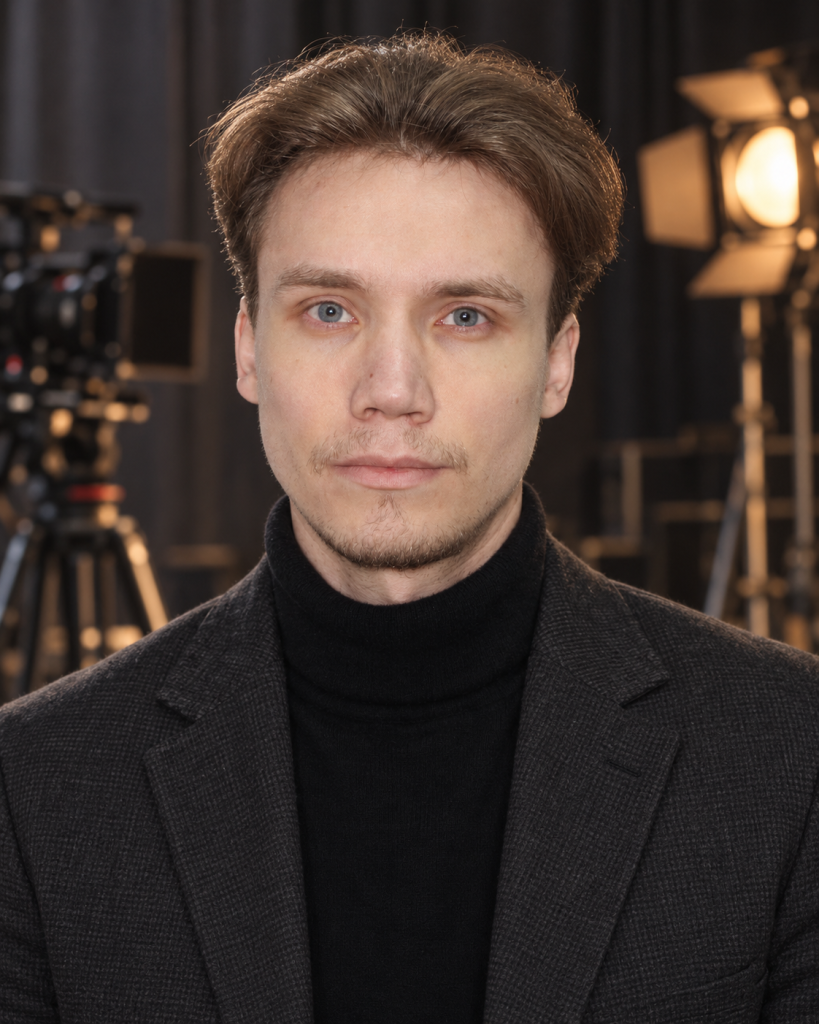
Researcher · Amerpass Research Lab
Oleg Leletskikh
Independent researcher · Actor
Actor and independent researcher of screen industries. His work examines Hollywood's institutional history, film-production geography, platform acting labor, and creative authority in independent film.
Biography and professional background
Oleg Leletskikh is an actor and independent researcher of screen industries. His professional experience spans film, theatre, and journalism. His research examines the organization of American screen production, creative labor, and the changing opportunities available to independent creators in digital environments.
His acting training includes the advanced screen-acting courses associated with AMEDIA in 2021 and study at the Boris Shchukin Theatre Institute in 2023 under V. A. Sazhin.
Leletskikh worked at the Voronezh State Theatre for Young Audiences. His theatre repertoire includes works by Nikolai Gogol, Mikhail Lermontov, Lope de Vega, Roland Schimmelpfennig, and Dmitry Bogoslavsky. His screen experience includes television, historical drama, and short films. Performance practice complements his interest in selection, preparation, temporary employment, and collaboration within creative teams.
A Kinoreporter editorial document dated 12 January 2025 identifies him as a correspondent and cameraman who had worked with the editorial team for the preceding two years. It also records work on a monograph about Hollywood cinema and a documentary about the history of Hollywood film production. As of 12 January 2025, the monograph and film were in progress.
At Amerpass Research Lab, his research connects the institutional history of film with professional identity, platform visibility, and the distribution of creative authority. Acting practice supplies a professional perspective, while the research arguments rely on the documentary evidence identified in the manuscripts.
Research interests and approach
The first strand concerns the institutional history of Hollywood. Leletskikh examines the transition from vertically integrated studios to production assembled through individual projects, contracts, professional networks, and platforms. Control over finance, intellectual property, distribution, and audience data is central to the analysis.
The second strand concerns the geography of screen production. Los Angeles is studied as a regional ecosystem of stages, workers, suppliers, and intermediaries; New York as a distributed production network connected to urban space, theatre, advertising, television, and public coordination. Comparing these models helps explain how temporary teams draw on durable local resources.
The third strand addresses acting labor in platform environments. The manuscripts consider self-taped auditions, digital profiles, casting services, the limited transparency of streaming compensation, and the use of voice and likeness in digital replicas. The central question is how tasks, costs, and risks move from organizations to individual performers.
The fourth strand examines the convergence of creative roles in independent film. It considers how acting, writing, producing, and directing can be combined during project formation, and how delegation, authorship, and decision-making authority change as a project grows.
Methods and sources
The presented studies use historical and institutional analysis, comparison of production models, and interpretation of documentary evidence. Their sources include film-industry and creative-labor scholarship, industry reports, employment statistics, professional associations, collective agreements, and public-policy documents. The prepared manuscripts do not describe planned interviews, trips, or production observations as completed fieldwork.
Research and prepared manuscripts
The following five research manuscripts are available in Leletskikh’s project. Historical dates identify an evidence cutoff or research version and are not used as proof of actual journal publication. Journal-style formatting does not establish peer review. No DOI or confirmed journal publication details are claimed for these works.
From the Studio System to Contemporary Hollywood: The Institutional Transformation of American Film Production
A study of the shift from the classical studio system to project-based and platform-centered Hollywood. It examines how production coordination moves from permanent studio departments to contracts and networks while control over capital, rights, and distribution remains institutionally significant.
Los Angeles as an Industrial Ecosystem: Infrastructure, Labor Networks, and the Geography of Film Production
Los Angeles is examined as an interdependent regional system of infrastructure, skilled labor, and production services. The study distinguishes physical capacity from actual activity and considers project mobility and the transfer of demand fluctuations to freelancers and specialized firms.
New York as a Distributed Production Model: Location Shooting, Independent Production, and the Urban Screen Economy
A study of distributed production in New York, including urban locations, stages, independent projects, neighboring cultural sectors, and administrative coordination. It focuses on urban space as temporary production infrastructure and the movement of workers between screen industries and other creative sectors.
Performance Labor in the Platform Era: Self-Tapes, Digital Visibility, and the Changing Boundaries of Acting
An examination of acting labor beyond the set. Self-taped auditions, digital-profile maintenance, platform selection, and rights management in recorded identity are treated as connected tasks that require resources and change the distribution of occupational risk.
The Multifunctional Creator: Role Convergence and Creative Authority in Contemporary Independent Film
A study of the combination of acting, writing, producing, and directing. Documented examples involving Issa Rae, Quinta Brunson, Jordan Peele, and Sean Baker support analysis of early project coordination, proofs of concept, rights distribution, and the limits of individual creative authority.
Research and creative projects
Two Capitals of the Screen
Working title: Two Capitals of the Screen: A Professional Journey through Hollywood and New York. Coauthor: Katarina Pogorelova. Status: book project in development.
The narrative nonfiction strand of a joint research and publishing program. The concept brings the professional perspectives of actors and journalists to two production cultures of the American screen. Interviews, observations, and archival materials form part of the proposed evidence work; their completion requires separate documentation.
Inside the American Screen
Russian working title: Beyond the American Screen: Hollywood, New York, and the Transformation of Film Production. Coauthor: Katarina Pogorelova. Status: academic monograph in development.
The analytical strand of the same program examines production institutions, acting labor, archival memory, and the distribution of creative authority. The prepared papers provide a thematic foundation for a future monograph; a completed or published book is not claimed.
Documentary on the history of film production
A joint project with Katarina Pogorelova, recorded by Kinoreporter in January 2025, concerning the history of Hollywood film production. Status as of 12 January 2025: the project was in progress.
Professional CV
Selected career stages
| Period | Activity |
|---|---|
| 2020 | Theatre roles in works by Gogol, Lermontov, Lope de Vega, Schimmelpfennig, and Bogoslavsky. |
| 2020–2022 | Screen work in Po sledu monstra. |
| 2021 | Advanced screen-acting training associated with AMEDIA. |
| 2022 | Participation in the historical film Imperiya: Pyotr I. |
| 2023 | Acting training at the Boris Shchukin Theatre Institute under V. A. Sazhin. |
| Documented in January 2025 | Kinoreporter correspondent and cameraman; the editorial team records two preceding years of collaboration. Work on a Hollywood monograph and documentary is recorded. |
| 2026 | Prepared research manuscripts on Hollywood, Los Angeles, New York, platform acting labor, and creative-role convergence; development of two book projects. |
Selected screen credits
| Work | Period / format | Role |
|---|---|---|
| Po sledu monstra («По следу монстра») | 2020–2022; documentary crime series | Pavel Voytov |
| Imperiya: Pyotr I («Империя: Пётр I») | 2022; historical drama | Anton Berezovsky |
| Ozero v lesu («Озеро в лесу») | Short film | Filipp; lead role |
| Istekayushchiy krovyu («Истекающий кровью») | Short film | Lenny; lead role |
| Vagner. Tango smerti («Вагнер. Танго смерти») | Short film | Konstantin; lead role |
Selected theatre credits
| Production | Playwright / year | Role |
|---|---|---|
| Before/After («До/После») | Roland Schimmelpfennig; 2020 | Man in the bar / wealthy man |
| Na khutore bliz Dikanki («На хуторе близ Диканьки») | Nikolai Gogol; 2020 | Vakula |
| Masquerade («Маскарад») | Mikhail Lermontov; 2020 | A mask |
| The Cleverly Enamored («Взволнованная (Хитроумная) влюблённая») | Lope de Vega; 2020 | A mask |
| Lyubov lyudey («Любовь людей») | Dmitry Bogoslavsky; 2020 | Kolya |
The professional biography also records experience at the Voronezh State Theatre for Young Audiences and advertising or modeling projects for The Bespoke Club (2019), Yango Deli (2021), and Estel (2022). Exact theatre-employment periods and dates of the short films are not provided in the available biography. Russian titles are retained alongside English renderings or transliterations to preserve identification.
Researcher identifier: ORCID 0009-0000-8264-5248.