
Researcher · Amerpass Research Lab
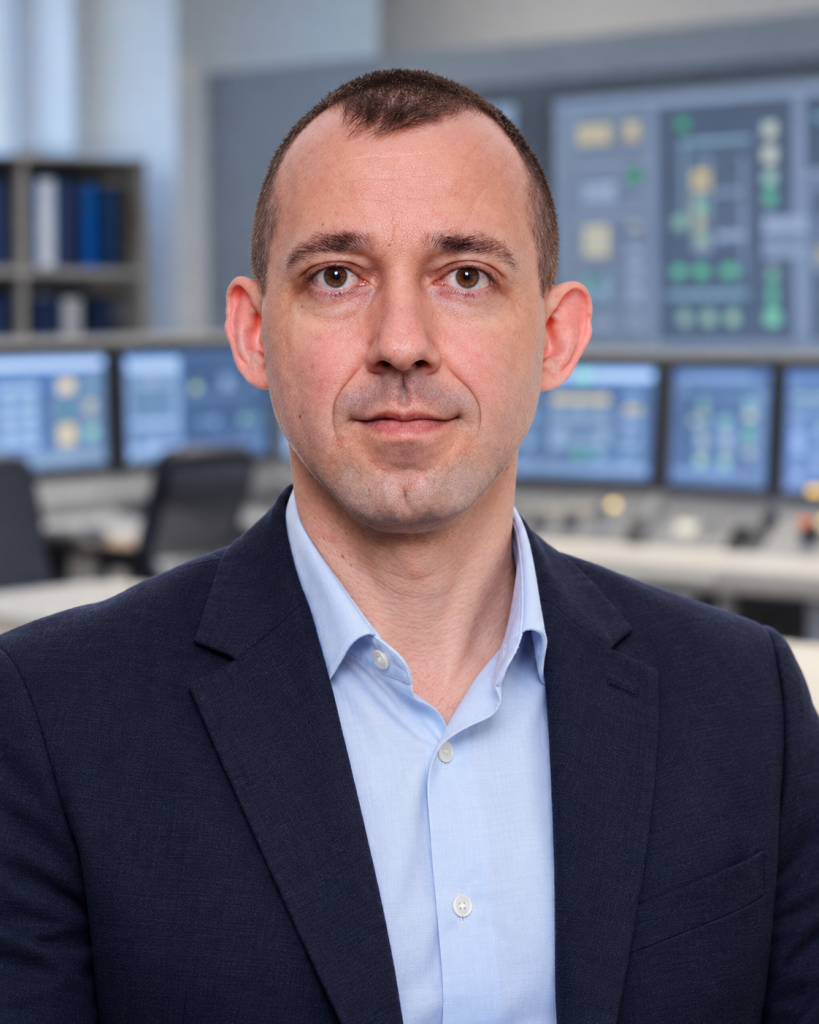
Dmytro Kucheruk
Independent researcher · Nuclear safety
Independent researcher of human and organizational factors in nuclear safety. Studies safety culture, knowledge transfer, professional judgment, and the resilience of critical infrastructure.
Biography and professional background
Dmytro Kucheruk is an independent researcher of the human and organizational dimensions of nuclear safety. His work connects extensive experience at the Zaporizhzhia Nuclear Power Plant with the study of professional knowledge, safety culture, and the resilience of critical infrastructure.
He worked at the Zaporizhzhia Nuclear Power Plant from 2005 to 2022. Installation work in a closely regulated industrial environment provided the practical foundation for his interest in how personnel preserve expertise, discuss technical problems, and sustain safe performance. His research places the professional community at the center of the relationship between equipment, operating requirements, and organizational procedures.
His program examines safety across the operating life of nuclear facilities. Extended plant operation, workforce renewal, and digital modernization create connected organizational questions: how can accumulated experience be retained, transmitted, and applied responsibly as circumstances change? Organizational memory, mentoring, professional judgment, and communication form the core of this inquiry.
A separate strand considers nuclear organizations facing prolonged external pressure and armed conflict. The Zaporizhzhia case provides a setting for examining changes in trust, reporting channels, workforce conditions, and the ability to express technically grounded concerns.
Research focus
Human factors in long-term nuclear operation
The continuity of competence, practical expertise, and organizational memory during extended plant operation. Particular attention is given to knowledge transfer between generations of personnel and the recognition of early signs of operational change.
Safety culture and professional communication
The conditions that support questions, risk reporting, and discussion of uncertainty. Trust, clear responsibility, and technical dialogue are examined as organizational resources that sustain reliability.
Professional judgment and procedural safety
The relationship between procedural discipline and interpretation of specific operating circumstances. Mentoring, shared technical discussion, and knowledge exchange are studied as mechanisms through which organizations develop sound judgment.
Resilience under non-routine conditions
Prolonged departures from ordinary operation that extend beyond a single emergency. This strand examines workload, adaptation in communication, and preservation of professional standards during sustained uncertainty.
Digital modernization and workforce preparation
A prospective strand of the program addresses the interaction of human expertise with automation, digital decision support, and artificial intelligence. Organizational readiness for advanced reactor technologies, including small modular reactors, is also part of the planned agenda.
Research papers and publications
The papers form a connected program covering extended operation, organizational adaptation, professional judgment, and safety culture under external pressure. Journal archive dates and available-version dates are identified separately where they differ.
Human Factors in the Long-Term Operation of Nuclear Power Plants: Challenges Beyond Technical Reliability
A conceptual study of extended nuclear operation through knowledge preservation, organizational memory, and workforce continuity. It examines why equipment assessment also requires attention to the professional environment that supports reliable use of technical systems.
From Routine to Resilience: Human Factors in Non-Routine Nuclear Operations
The paper identifies prolonged non-routine conditions as an analytical domain between ordinary operation and emergency response. Resilience is examined through an organization’s capacity to sustain safe performance during change by preserving shared understanding, transferring knowledge, and adapting professional interaction.
Professional Judgment in Nuclear Operations: The Limits of Procedural Safety
The paper approaches professional judgment as a capability shaped within organizations. It examines mentoring, technical dialogue, and retention of practical experience. Procedures provide the framework for safe work, while professional understanding supports their application to particular operating circumstances.
Human Factors and Safety Culture at Nuclear Power Plants During Armed Conflict: Lessons from the Zaporizhzhia Nuclear Power Plant
A conceptual examination of the Zaporizhzhia case as a setting in which armed conflict changes the professional environment of nuclear work. It addresses psychological pressure, workforce resilience, responsibility, and the preservation of risk reporting. The analysis draws on professional experience and available scholarly and institutional literature.
Research program and projects
Human and organizational foundations of long-term nuclear safety
A long-term program connects the study of knowledge, decisions, safety culture, and adaptation in nuclear organizations. Its practical objective is to improve understanding of how a reliable professional environment can be sustained across decades of operation. The foundation comprises four prepared papers and a research statement developed in 2026.
Status: developing independent research program. Its proposed directions and outputs describe future work.
| Program stage | Central question |
|---|---|
| 1. Knowledge and continuity | How are practical expertise, organizational memory, and mentoring maintained during workforce transitions? |
| 2. Organizational decisions | Which forms of technical dialogue and shared learning support procedural application in complex circumstances? |
| 3. Digital transformation | How do automation and new decision-support systems interact with professional responsibility? |
| 4. Advanced reactor technologies | What workforce preparation and organizational readiness are needed for new nuclear facilities? |
| 5. Integration | How can knowledge, judgment, and resilience be connected in a common framework for long-term safety? |
Professional CV
Professional and research experience
| Period | Activity |
|---|---|
| 2005–2022 | Zaporizhzhia Nuclear Power Plant. Installation work in a regulated industrial environment; practical experience of safety requirements and professional interaction at a nuclear facility. |
| Research line 2024–2026 | Human factors in extended operation, non-routine conditions, professional judgment, and safety culture during armed conflict. Four papers are represented in the 2026 research portfolio. |
| 2026 | Formulation of a long-term program on human and organizational foundations of nuclear safety; posting of the professional-judgment paper to SSRN. |
Research approach
Conceptual analysis, reflection on professional practice, and examination of scholarly literature and institutional materials on nuclear safety. Core subjects include organizational learning, knowledge transfer, safety culture, professional judgment, and workforce resilience.
Researcher identifier: ORCID 0009-0009-9179-9500.